
Dynamics GP vs. Business Central: A Feature-by-Feature Comparison for Finance Teams

Why this comparison is no longer optional
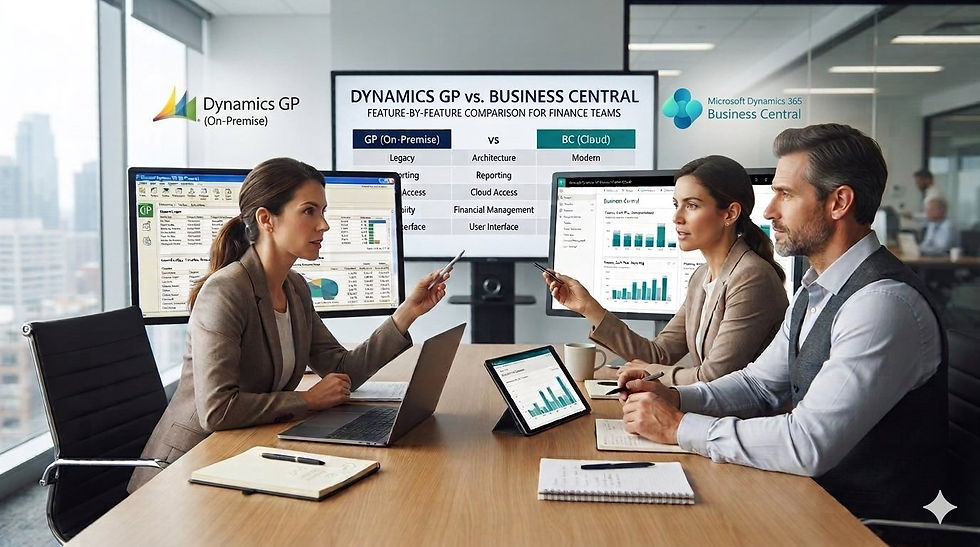
Somebody on your team forwarded an article about Dynamics GP's support timeline, or your auditor asked what the long-term plan for your ERP is, or you just noticed that every new Microsoft feature announcement mentions Business Central and never GP. None of that means you have to decide anything today. It does mean you need a clear-eyed, feature-by-feature comparison instead of a vague sense that "GP is old and BC is new." This post lays out the real Dynamics GP vs Business Central picture: where the two platforms still do the same job, where Business Central pulls ahead, and where the gap actually matters for a finance team, not just for IT.
Where GP and Business Central still do the same job
Start with what doesn't change: Business Central covers the core functionality GP users depend on every day, including general ledger, accounts payable, accounts receivable, bank reconciliation, and inventory. If your GP usage is mostly transactional finance, the day-to-day mechanics of entering a batch, cutting a check, or reconciling a bank account will feel familiar within a few weeks. Business Central is not re-inventing double-entry bookkeeping, and a well-scoped migration should not force your controller to relearn accounting from scratch.
Where Business Central goes further
Where the two platforms diverge is scope. GP was built primarily as a financial system, with sales, service, and warehouse functionality often bolted on through third-party ISV add-ons over the years. Business Central builds on the same financial foundation but ships with integrated sales, purchasing, inventory, supply planning, and project management natively, designed to connect departments and processes across the organization rather than stitch them together after the fact — a true ERP for small-to-medium-sized businesses. For a finance team that has spent years reconciling data between GP and three or four add-on systems, this is often the biggest operational relief that Business Central can provide.
The reporting gap most finance teams underestimate
This is the difference that shows up first in month-end, and it's easy to underestimate until you've lived with it. GP's native reporting tools were built for a different era, and most GP shops end up leaning on SmartLists, Management Reporter, or manual Excel exports to get anything close to a real management report. Business Central's reporting is built around dimensions, which let you slice a single transaction however your business needs to see it.
Common examples of dimensions are department, location, and project, but dimensions can be defined specifically for the way you see your business without maintaining a parallel chart of accounts to do it. It also connects natively to Power BI, so a dashboard can pull live data instead of last week's export. If your team already invests real time in a BI & Reporting layer on top of GP today, this is the area where a platform change actually reduces that workload instead of just moving it.
AI and automation: a capability GP was never built for
Dynamics GP does not include native AI or predictive analytics; teams rely on manual analysis or external tools bolted on afterward. Business Central ships with built-in generative AI through Copilot, which can help with tasks like drafting customer payment reminders, summarizing cash positions, or flagging anomalies in a set of transactions before they turn into a bigger reconciliation problem. This isn't a reason on its own to migrate, but it's a fair measure of where each platform's engineering investment has gone for the past several years, and it tells you which direction that gap will keep widening.
The Microsoft ecosystem question
Business Central was built to work inside the broader Microsoft ecosystem your team probably already lives in: Outlook, Excel, Teams, and the Power Platform. That means a customer record or an approval workflow can surface inside Teams or Outlook instead of requiring a separate login. GP can be connected to these tools too, but usually through custom integration work rather than native design, which adds a maintenance line to your IT budget that Business Central mostly removes.
What Microsoft's own roadmap tells you
Dimension | Dynamics GP | Business Central |
Deployment | On-premise, with limited cloud add-ons | Cloud, on-premise, or hybrid |
New features | None planned by Microsoft | Twice-yearly major releases plus monthly updates |
Reporting | SmartLists, Management Reporter, manual exports | Native dimensions, Power BI connector |
AI | None native | Copilot built in |
Support end | Dec 31, 2029 (critical security patches to Apr 30, 2031) | Actively supported and developed |
Microsoft has been explicit that it is not developing new features for Dynamics GP, while Business Central continues to evolve on a public, predictable release cadence. Mainstream GP support, including tax and regulatory updates, ends December 31, 2029; critical security patches are expected to continue only through April 30, 2031, and only at Microsoft's discretion. New Dynamics GP licenses are also no longer being sold, which means every new deployment decision at a GP-using company is already being made in Business Central's favor by default. None of this requires an immediate move, but it does mean the feature gap in the table above is not going to close on its own.
What this means for your next decision
A feature comparison isn't the same as a migration plan. If your GP environment is lean, with few customizations and a small ISV footprint, the case for Business Central is mostly about future-proofing reporting and removing the support-date clock. If your GP environment carries fifteen years of customizations, several ISV add-ons, and a multi-entity structure, the comparison above is the first input into a much longer conversation about scope, cost, and sequencing. Either way, it's worth running this comparison against your specific GP setup rather than a generic feature list, and the Dynamics GP services team can walk through that with your actual customization and add-on list in hand.
If you want this Dynamics GP vs Business Central comparison mapped against your own environment rather than a generic feature list, contact us and we'll walk through it together.
Frequently Asked Questions
Is Business Central just a cloud version of GP?
No. Business Central was designed from the ground up as its own product, not a rehosted version of GP. The interface and workflows are actually based on Dynamics NAV. Some workflows will feel familiar, but the data model, reporting approach, and underlying architecture are different enough that a migration is a real project, not a simple reinstall.
Will our GP reports transfer directly to Business Central?
Not directly. Because Business Central's reporting model is built around dimensions rather than GP's structure, most reports need to be rebuilt rather than copied over. This is worth planning for early rather than discovering during user acceptance testing.
Do we lose any functionality moving from GP to Business Central?
Most SMB finance and operations functionality carries over or improves. The exceptions tend to be deep, specific customizations or niche ISV modules (heavy manufacturing configurations, for example) that may need a Business Central-native replacement rather than a direct port.
How much time do we actually have before this becomes urgent?
Mainstream support ends December 31, 2029, with critical security patches possibly continuing through April 30, 2031 at Microsoft's discretion. That sounds distant, but mid-market GP to Business Central migrations typically take 9 to 18 months, longer for complex, multi-entity, or heavily customized environments, so the planning window is shorter than the support date suggests.
Is Business Central the only place we can land if we leave GP?
No. Business Central is the most natural landing spot for GP customers already in the Microsoft ecosystem, but it isn't the only option, and it isn't automatically the right one for every business. It's worth evaluating it alongside other cloud ERP platforms before committing.
References
This post draws on Microsoft's published Dynamics GP lifecycle policy and end-of-support announcement, along with independent feature-comparison analyses of Dynamics GP and Business Central from ERP consulting firms including Western Computer, Cargas, Encore Business Solutions, and ERP Software Blog.


Comments