
The Hidden Cost of Staying on Dynamics GP Too Long


Why the cost of staying is easier to ignore than the cost of moving
A migration has a visible price tag attached to a proposal, which makes it easy to scrutinize and easy to delay. Staying on Dynamics GP has a cost too, but it's spread across many line items: IT overtime, contractor fees, software renewals, and slower month-end processes. Because those expenses rarely appear as a single number requiring approval, the cost of staying can be underestimated. The right comparison is not a migration quote versus today's software renewal. It's the full cost of operating GP over the same planning horizon.
The direct maintenance line is usually understated
The software maintenance invoice is only part of the story. In a survey published by ServiceNow, the average annual labour cost per IT worker associated with maintaining legacy systems was approximately $39,000, with the figure varying substantially by industry. This is a cross-industry, per-worker labour estimate, not a Dynamics GP license fee, an amount per application, or a forecast for an individual company. For GP, add your own software renewals, internal support hours, infrastructure, customizations, and ISV add-on costs to see the actual maintenance burden.
The talent premium is rising specifically for GP
Dynamics GP often depends on experienced specialists, including consultants familiar with long-standing customizations and Dexterity development. If the people who know a company's implementation retire, change practices, or become less available, knowledge transfer and specialist coverage can become more expensive and difficult. Rather than assume a universal talent premium, check the current rates, response times, and succession arrangements of the providers who support your specific environment.
Total cost of ownership is more than the visible maintenance number
The true total cost of ownership includes more than an annual support invoice: internal IT effort, outside specialists, infrastructure, ISV renewals, compliance work, downtime, and time spent on manual workarounds. Those costs can materially change a keep-versus-migrate business case, but there is no dependable universal multiplier for every GP environment. Calculate each component using your own invoices, usage data, and finance-team estimates, taking care not to count the same labour twice.
Legacy maintenance quietly consumes the IT budget meant for growth
Maintaining existing systems can take a substantial share of technology budgets. In a 2025 Cognizant study, respondents reported allocating 61% of their technology budgets to maintaining existing systems, with plans to reduce that share by 2030. That figure covers legacy technology broadly, not Dynamics GP specifically. The strategic question for a GP customer is how much of its own budget and staff capacity is tied up in maintenance rather than reporting, automation, and other improvements.
The cost curve gets steeper, not flatter, over time
Legacy technology can become more expensive to maintain as dependencies age, integrations require attention, and institutional knowledge becomes harder to replace. That does not mean every GP environment follows the same five-year cost curve. Microsoft confirms that Dynamics GP product enhancements, regulatory updates, and technical support end December 31, 2029; security updates, if needed, will be available until April 30, 2031. Those published milestones are a reason to review the cost and support plan now, rather than assume today's run-rate will remain unchanged.
Where the breakeven point usually lands
There is no single reliable 24-to-36-month breakeven point for every ERP modernization. To estimate your own, compare three- to five-year scenarios for maintaining GP and moving to a supported platform. Include implementation and training expenses, subscriptions, integration work, expected efficiency gains, and the risks and costs of staying. The point at which cumulative savings exceed migration costs depends on the assumptions in your model, which is why the exercise is best completed with finance stakeholders and an ERP services partner.
Frequently Asked Questions
Isn't it cheaper to just keep GP running as-is with minimal changes?
It may be cheaper in the short term because support and maintenance costs are spread across multiple line items rather than one migration proposal. The longer-term answer depends on your actual support costs, manual work, integrations, and the investment required to modernize.
How do we actually calculate our own total cost of ownership?
Start with your direct software and support renewal costs, then add internal IT hours spent on GP-related issues, contractor invoices, ISV renewal fees, and a rough estimate of time lost to manual workarounds. That combined figure is a far more honest number than the support renewal line alone.
Does the talent shortage really affect a smaller SMB environment?
Potentially. Smaller environments may depend on one external specialist or firm, so the loss of that provider can have an outsized operational effect. Review your own support coverage and knowledge-transfer arrangements rather than relying on a general market assumption.
When does it make sense to start this calculation?
Start now, while you still have options to plan deliberately. A baseline of support costs, staff time, and process delays helps you decide whether to maintain, improve, or migrate GP without waiting for a forced change.
Sources & Further Reading
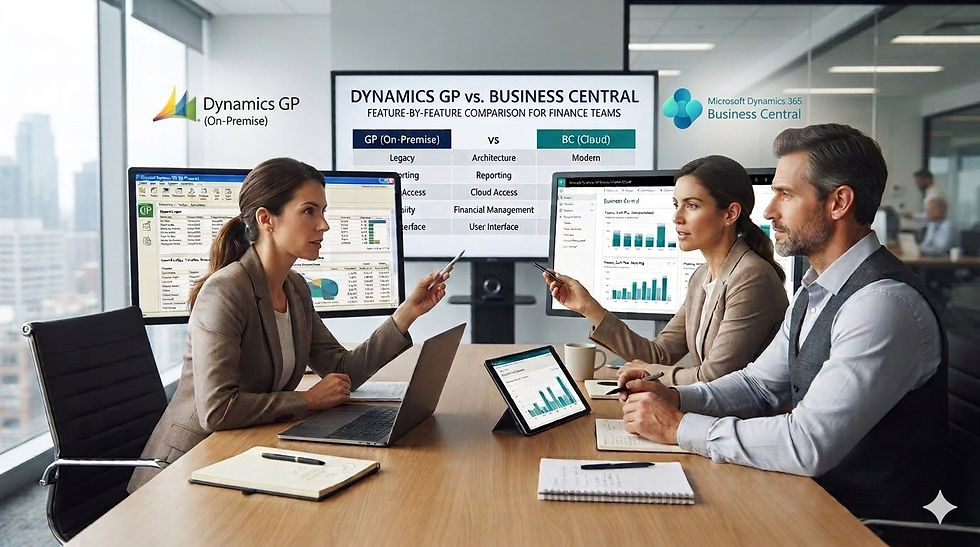
For more background on the platforms, see EEZEE Solutions' Dynamics GP vs. Business Central comparison.


Comments